"We released 1,200 licences without any support. I'm embarrassed to say it."— Data-driven IT Lead
Turning Conversations into Context
AI exposes your real constraints. D3 helps you address them through better collaboration, not tooling. Built from real engagements by practitioners at Equal Experts.
Counterintuitive Findings
These findings often catch teams off guard when they start working with AI tools.
Everyone has access to the same AI tools. The difference is how teams collaborate and create context for those tools to use. The tooling matters less than the conversations that feed it.
Writing code was never the bottleneck. When AI can generate code in minutes, the real constraints become obvious. Architecturally: tight coupling, shared infrastructure, slow builds, testing bottlenecks. Organisationally: unclear requirements, delayed decisions, stakeholder unavailability. AI accelerates development so much that you'll hit these constraints in days instead of weeks.
AI doesn't replace thinking about systems. It raises the bar—you need to understand what good design looks like to review AI-generated code effectively. System design, architectural judgment, and code review skills become more important, not less.
What Doesn't Work
Learning from what went wrong across different teams and projects.
Deploying 1,200 licences without support, training, or structured adoption. Teams get tools but not practices. Six months later, usage is at 20% and nobody knows why.
Innovation teams exploring AI in labs, but findings never reach the teams shipping software. Double work across business units, no sharing back. Each team inventing their own approach.
Big consultancies pushing proprietary platforms. You adopt their tooling, then can't leave. The capability lives in their platform, not your team.
Don't make stakeholders collaborate in markdown files hidden in Git repositories. Product managers and designers shouldn't need to learn Git workflows to contribute to specifications.
Since it's easy to generate information, people and tools tend to create loads of artifacts. This increases cognitive load and makes it harder to maintain review discipline.
More time tweaking workflows than shipping. Pick an approach, deliver, learn, adjust. Delivery creates feedback.
Dialog Driven Delivery
Developed with Equal Experts from real client engagements. D3 packages what we learned into a repeatable approach.
Product, engineering, and design thinking together is the default, not optional. These conversations produce context that isolated documentation never can. AI makes capturing and structuring this dialog practical for the first time.
AI follows context. The richer and more structured that context, the better the output. Building it—capturing dialog, structuring specifications, curating decisions—is the work that determines whether AI tools help or hinder.
AI drafts. Humans review. Every specification, every story, every decision passes through human judgment. Speed without review is just faster mistakes. We use AI to accelerate, not to bypass the people accountable for outcomes.
Built for collaboration, not bolted on
Not tied to a specific AI vendor or model
Teams deliver software, not individuals with AI
Works with existing tools, legacy systems, compliance requirements
Document where knowledge compounds, not at task level
Mark assumptions and open questions to prevent AI invention
Start with a cross-functional conversation. Product, engineering, design—together. Capture the dialog where shared understanding forms.
Context comes from everywhere. Dialog, designs, prototypes, technical decisions, user feedback. Specifications evolve through whatever inputs emerge.
Turn shared understanding into deliverable work. Break features into stories that stay connected to their source context.
Context flows to code. Findings flow back to specifications. The bridge between conversation and implementation stays current.
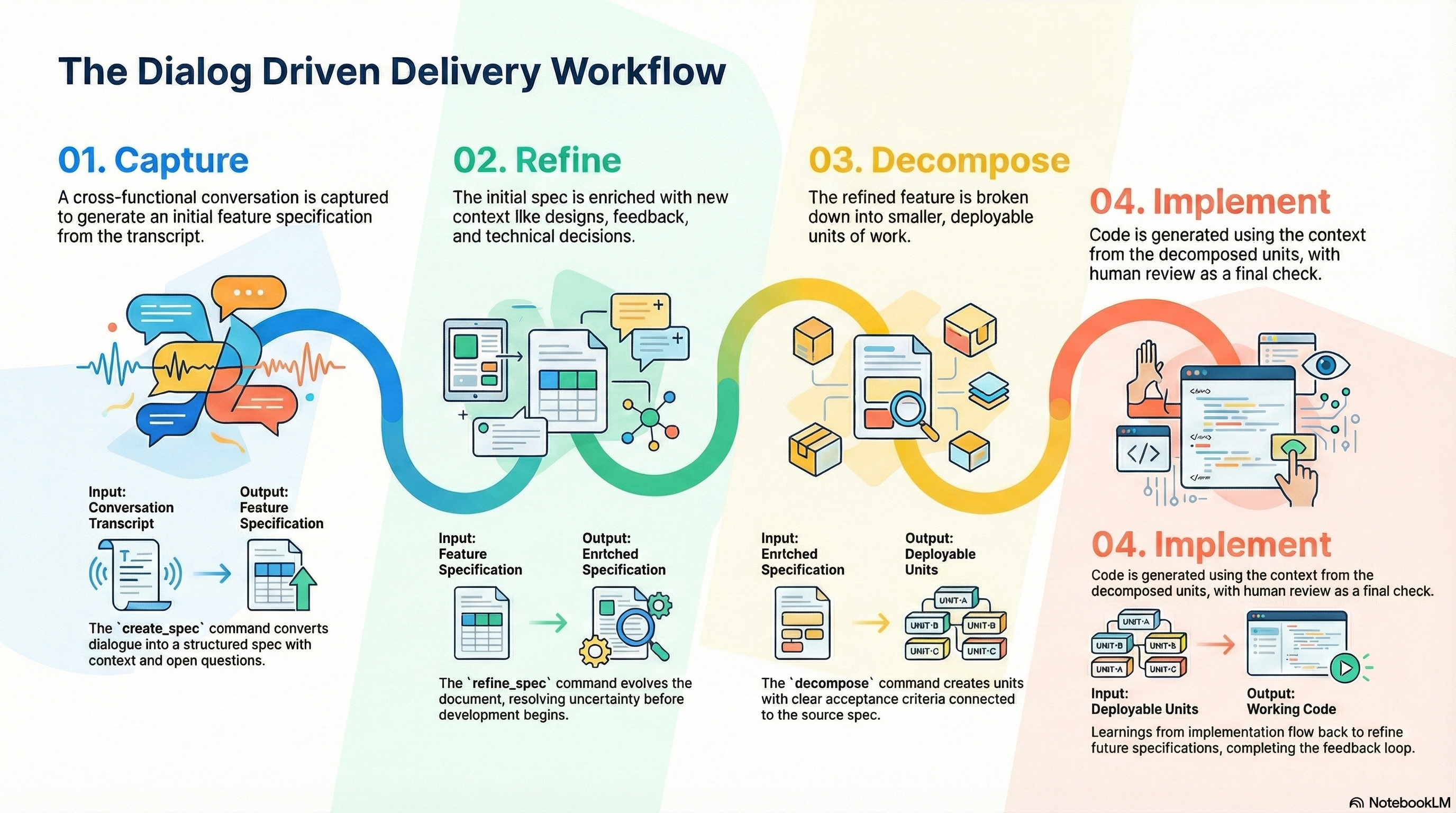
This is our baseline implementation. The commands and workflow are what we use. The tooling is adaptable—built on Claude Code with Atlassian Jira and Confluence, but migrates to other tools.
Takes a conversation transcript and generates a feature specification. Captures context, decisions, constraints, and open questions from the dialog.
Evolves the specification as new context emerges. Add designs, technical decisions, user feedback—specifications stay living documents.
Breaks features into smaller deployable pieces with clear acceptance criteria. Each piece stays connected to its source specification.
We provide starter templates for specifications and stories. The templates encode the patterns we've found useful. Adapt them to your team's needs as you learn.
Outcomes
Shared understanding is created collaboratively, rather than translated across documents and roles.
Uncertainty and disagreement are addressed early, when they're cheap to resolve.
Clear, structured context improves output quality and builds trust across engineering teams.
Practices that work across federated organisations, not locked inside individual experts.
Tactical Patterns
Practices that consistently help teams beyond the D3 framework.
Architecture, CI/CD, and testing infrastructure should enable AI to iterate and self-correct. Tests, linting, and type systems provide deterministic validation—AI can check its own work and improve before human review. Design for this from the start.
Have AI generate an implementation plan first. Review the approach before any code gets written. This catches misunderstandings early—when changing direction is cheap. Execute only after human sign-off on the plan.
Let AI review code before humans do. AI catches issues, iterates on fixes, and brings cleaner code to human review. Run multiple review flavors in parallel—security review, performance review, style review—each surfacing different concerns. If available, combine different models for review; each has different strengths.
Start with minimal instructions for AI. Add rules and guardrails based on patterns you see in pull requests. If AI keeps making the same mistake, add a guideline. Team context grows from real feedback, not upfront speculation about what might go wrong.
Equal Experts helps teams and organisations adopt AI-enabled delivery practices. Whether you're piloting with a single team or rolling out across the organisation, let's talk about what works for your context.